Is Pineal Guard Safe? – Side Effects, Warnings, and Who Should Avoid It
Considering Pineal Guard often comes with questions about its safety, possible side effects, and suitability for different individuals. Before adding this supplement to your daily routine, you may want to understand its ingredients, review the available safety information, and determine whether any components could interact with medications or existing health conditions. Looking beyond promotional claims is especially important when evaluating supplements intended to support brain health, sleep, or general well-being.
In this detailed guide, we’ll explore Pineal Guard’s potential side effects, important precautions, and who should seek medical advice before using it. We’ll also discuss how to review the product label, why natural ingredients are not automatically risk-free, and which safety details deserve particular attention. Because the exact risks depend on the formula, ingredient amounts, and individual circumstances, it’s important to verify the current label rather than assume the supplement is suitable for everyone. By the end, you’ll have a clearer understanding of the safety questions to consider before deciding whether Pineal Guard is appropriate for you.
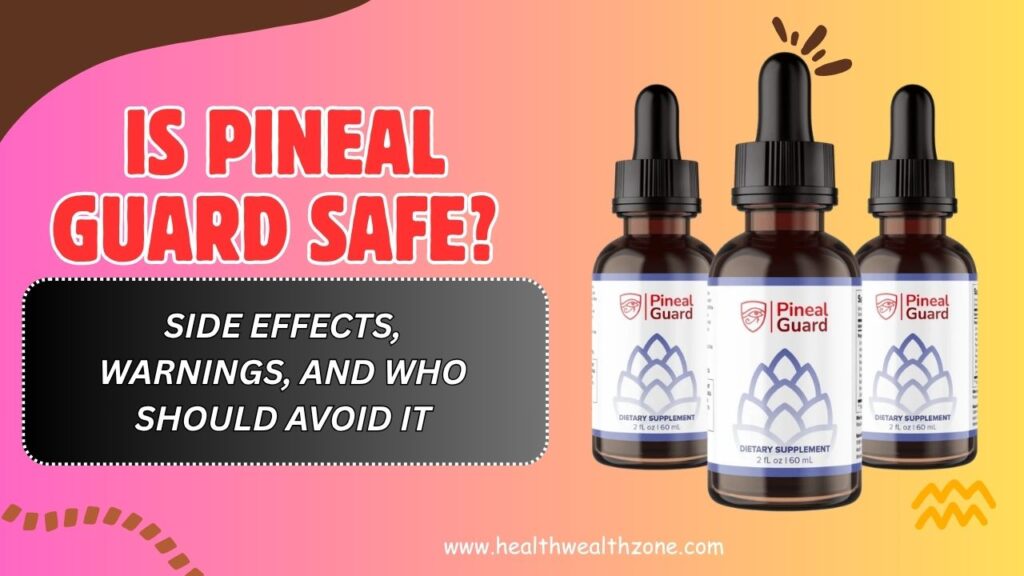
What Is Pineal Guard?
Pineal Guard is a liquid dietary supplement built around a nine-ingredient botanical formula.
The ingredients listed by the manufacturer include:
- Pine Bark Extract
- Tamarind
- Chlorella
- Ginkgo Biloba
- Spirulina
- Lion’s Mane Mushroom
- Bacopa Monnieri
- Moringa
- Neem
The product is presented as a plant-based, non-GMO, stimulant-free formula in liquid form. The manufacturer also states that users should consult a physician if they have a medical condition or take prescription medication.
The pineal gland itself has an established biological role in producing melatonin, which helps regulate the body’s sleep-wake cycle. However, that biological role should not be confused with evidence that a particular supplement can treat a pineal-gland disorder.
Is Pineal Guard Safe?
There isn’t enough independent clinical evidence on the complete Pineal Guard formula to conclude that it is universally safe for every person.
That doesn’t mean the product is necessarily unsafe. Rather, safety depends on factors such as:
- Your age
- Existing medical conditions
- Prescription and over-the-counter medications
- Allergies and sensitivities
- Individual tolerance
- The amount and frequency used
The manufacturer itself advises people with medical conditions or those taking prescription medication to consult a physician before using Pineal Guard.
For that reason, it is more accurate to evaluate the safety of the individual ingredients and the user’s circumstances rather than assuming that a plant-based formula is automatically risk-free.
Potential Pineal Guard Side Effects
Product-specific clinical safety data for the complete Pineal Guard formula are limited. Therefore, claims that the product has absolutely no side effects would go beyond the available evidence.
Instead, it is useful to consider known safety information about some of its individual ingredients.
Ginkgo Biloba
Ginkgo Biloba is one of the most extensively studied ingredients in Pineal Guard.
According to the National Center for Complementary and Integrative Health, oral Ginkgo leaf extracts are generally well tolerated by many people, but reported side effects can include dizziness, headache, and gastrointestinal symptoms.
A more important consideration is its potential effect on bleeding.
Ginkgo may interact with anticoagulant or antiplatelet medications, so people taking blood-thinning medication should discuss its use with a healthcare professional before using a product containing Ginkgo.
Bacopa Monnieri
Bacopa Monnieri has a long history of traditional use and has also been studied for cognitive wellness.
Although research suggests that Bacopa may be tolerated by many people, individual digestive or other reactions can occur. There may also be medication-interaction considerations.
If you’re taking prescription medication regularly, checking with a doctor or pharmacist before using a Bacopa-containing supplement is a sensible precaution.
Other Botanical Ingredients
Pineal Guard also contains Neem, Moringa, Spirulina, Chlorella, Tamarind, Pine Bark Extract, and Lion’s Mane Mushroom.
Safety information varies considerably between these ingredients, and the effects can depend on the specific extract, concentration, dose, and individual circumstances.
This is one reason why it is better not to assume that every person will respond to the complete formula in exactly the same way.
Who Should Avoid Pineal Guard or Consult a Doctor First?
Certain people should take extra care before adding a multi-ingredient dietary supplement to their routine.
People Taking Blood-Thinning Medication
This is one of the most important considerations because Pineal Guard contains Ginkgo Biloba.
Ginkgo may increase bleeding risk and can interact with certain medications. Anyone taking anticoagulant or antiplatelet medication should speak with a healthcare professional before using Pineal Guard.
People Preparing for Surgery
Anyone preparing for surgery should tell their healthcare provider about all supplements they are taking.
Because Ginkgo may have an effect on bleeding, a medical professional can determine whether the supplement should be stopped before a procedure.
Don’t make assumptions based solely on the fact that the product contains natural ingredients.
Pregnant or Breastfeeding Women
Pregnancy and breastfeeding are situations where extra caution with herbal supplements is appropriate.
There may be insufficient safety information for individual ingredients or particular combinations during pregnancy or breastfeeding.
Therefore, pregnant or breastfeeding women should consult a qualified healthcare professional before using Pineal Guard.
People Taking Prescription Medication
If you’re currently taking prescription medication, speak with your doctor or pharmacist before starting Pineal Guard.
This is particularly important when medications affect:
- Blood clotting
- Blood pressure
- Blood sugar
- The nervous system
- Liver metabolism
- Other medication-sensitive processes
A healthcare professional can review the complete ingredient list and determine whether any potential interactions are relevant to you.
People With Existing Medical Conditions
People with chronic or ongoing medical conditions should also exercise caution.
Rather than trying to determine compatibility independently, provide your healthcare professional with the complete Pineal Guard ingredient list and the exact medications or supplements you currently use.
This allows them to assess the situation based on your individual circumstances.


Can Pineal Guard Interact With Medications?
Potentially, yes.
The most notable consideration is Ginkgo Biloba, which can interact with certain medications, particularly drugs associated with blood clotting and bleeding.
Other botanical ingredients may also have potential interactions, although the clinical importance can vary depending on dosage and the specific medication involved.
This doesn’t mean everyone taking medication will experience an interaction. It means that people taking medication shouldn’t assume that Pineal Guard is automatically compatible simply because it contains plant-based ingredients.
A doctor or pharmacist is the appropriate person to check the complete combination.
How to Use Pineal Guard Responsibly
If Pineal Guard is appropriate for you, several straightforward precautions can help you use the product responsibly.
Follow the Recommended Directions
Follow the serving instructions provided with the product rather than assuming that taking more will provide greater benefits.
The manufacturer currently recommends taking one drop per day, preferably in the morning, and advises users to shake the bottle before use.
Review the Complete Ingredient List
Don’t focus only on the product’s primary marketing message.
Review all nine ingredients and consider whether any of them could be relevant to your medications, allergies, or existing health conditions.
Don’t Replace Medical Treatment
Pineal Guard is a dietary supplement and should not be used as a replacement for diagnosis or treatment from a qualified healthcare professional.
If you have persistent sleep problems, neurological symptoms, hormonal concerns, or another health issue, professional medical evaluation is more appropriate than relying solely on a supplement.
Pay Attention to Your Individual Response
Everyone can respond differently to supplements.
If you experience an unusual, persistent, or severe reaction after taking Pineal Guard, stop using it and seek appropriate medical advice.
Pineal Guard Ingredients and Safety Considerations
| Ingredient | General Safety Consideration |
|---|---|
| Pine Bark Extract | Discuss use with a healthcare professional if taking medication or managing a medical condition. |
| Tamarind | Individual tolerance can vary; medication use should be considered. |
| Chlorella | Consider individual allergies, tolerance, and medication use. |
| Ginkgo Biloba | May cause headache, dizziness, or digestive symptoms and may increase bleeding risk with certain medications. |
| Spirulina | Individual tolerance and product quality are important considerations. |
| Lion’s Mane Mushroom | Safety data can vary depending on preparation and long-term use. |
| Bacopa Monnieri | May cause digestive effects in some people and may have medication-interaction considerations. |
| Moringa | People taking medication should discuss use with a healthcare professional. |
| Neem | Safety can depend on preparation, amount, and individual circumstances. |
Pineal Guard Pricing & Packages
Here’s the current pricing structure shown in the offer:
| Package | Price per Bottle | Total Price | Supply | Shipping |
|---|---|---|---|---|
| 1 Bottle | $69 | $69 | 1 Month | Paid separately |
| 3 Bottles | $59 | $177 | 3 Months | Paid separately |
| 6 Bottles | $49 | $294 | 6 Months | ✅ Free Shipping |
The official product page identifies the 3-bottle package as Most Popular and the 6-bottle package as Best Value. It also states that orders of more than two bottles qualify for free shipping.
The official page currently advertises a 365-day money-back guarantee.
Final Verdict: Is Pineal Guard Safe? – Side Effects, Warnings, and Who Should Avoid It
If you’re considering Pineal Guard to support your sleep, relaxation, or general wellness, understanding its ingredients and potential safety concerns is essential before making a purchase. Like any supplement, its suitability depends on the specific formula, serving instructions, possible ingredient sensitivities, and your individual health circumstances. Pineal Guard may be worth exploring as a potential wellness supplement, provided you review its ingredients carefully and maintain realistic expectations about its advertised benefits. However, without reliable product-specific safety research, it would be premature to assume that it is completely safe or suitable for everyone simply because it is marketed as a natural formula.
Before using Pineal Guard, check the complete ingredient list, recommended serving, possible allergens, and manufacturer warnings. People who take prescription medication, have existing medical conditions, or are sensitive to particular ingredients should consult a qualified healthcare professional before starting the supplement. If you’re considering buying Pineal Guard, review the latest product information and purchase terms on the official website, and verify any advertised money-back guarantee before ordering. Remember that individual responses can vary and supplements should not replace medical advice or prescribed treatment. If you experience unexpected symptoms after taking a supplement, stop using it and seek appropriate medical guidance.