How to Use Easy Battery Fix for Best Results – Tools, Timing, and Tips
Ready to use Easy Battery Fix but not sure where to start? Getting the right tools, following the proper steps, and choosing the right timing can make the process easier and help you avoid common mistakes. But what equipment do you need, when should you use Easy Battery Fix, and which simple tips can help you get better results?
In this detailed guide, we’ll explain how to use Easy Battery Fix, the tools you may need, recommended timing, basic steps, safety tips, and practical advice to help you use the method correctly and responsibly.
👉 Don’t wait — Order Easy Battery Fix now from the Official Site
What Exactly Is Easy Battery Fix?
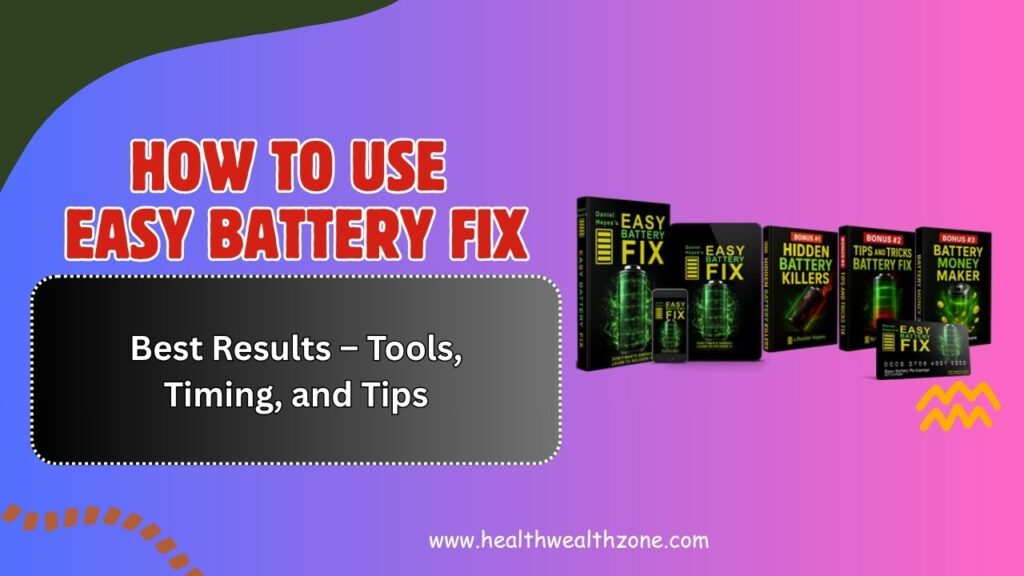
Easy Battery Fix is a digital battery-reconditioning guide designed to teach users how to evaluate, potentially restore, and maintain certain rechargeable batteries.
Unlike a battery charger or physical repair device, the program provides educational instructions that users can follow themselves. Its promotional materials describe a Battery Reset Sequence, a quick battery check, tools and setup information, safety and testing protocols, and troubleshooting guidance.
The program is aimed at DIY users who want to learn more about batteries and potentially reduce replacement costs.
The main areas covered include:
- Battery testing and diagnosis
- Battery-reconditioning techniques
- Tools and setup
- Safety precautions
- Troubleshooting
- Battery maintenance
- Battery-life extension strategies
It’s important to understand that Easy Battery Fix doesn’t guarantee every battery can be restored. A battery with permanent internal damage may need replacement regardless of the method used.
👉 Don’t wait — Order Easy Battery Fix now from the Official Site
How to Use Easy Battery Fix Step by Step
The best approach is to avoid rushing directly into the restoration procedure. Start by understanding the battery and establishing whether it is a sensible candidate for further testing.
1. Identify the Battery Type
First, determine what kind of battery you’re dealing with.
Common rechargeable battery types include:
- Lead-acid
- AGM
- Gel
- Lithium-ion
- NiMH
- NiCd
Battery chemistry matters because charging characteristics, failure modes, and safety requirements differ considerably.
Never assume that a technique suitable for one battery type is automatically safe for another.
2. Inspect the Battery
Before connecting a charger or testing equipment, inspect the battery carefully.
Look for:
- Swelling
- Cracks
- Leakage
- Severe corrosion
- Burn marks
- Physical deformation
- Unusual odors
If a battery appears physically damaged, stop rather than attempting DIY restoration.
3. Perform an Initial Battery Test
Easy Battery Fix promotes a quick check to determine whether a battery may be recoverable.
A digital multimeter can help establish a baseline voltage. Record the initial measurement so you have something to compare against later.
However, remember that voltage alone doesn’t prove battery health. A battery can display voltage while having severely reduced capacity.
4. Follow the Battery Reset Sequence
Once you’ve established that the battery is an appropriate candidate, follow the program’s Battery Reset Sequence instead of improvising.
The goal is to apply the procedure consistently and according to the battery type.
Avoid shortcuts that aren’t specifically recommended for your battery.
5. Recharge and Test Again
After completing the relevant process, recharge the battery using a suitable charger and then test it again.
Compare the new results with your original measurements.
This gives you a better indication of whether the battery has actually improved rather than relying on the assumption that restoration worked.
What Tools Do You Need?
One of the practical aspects of Easy Battery Fix is its focus on a relatively straightforward setup.
Digital Multimeter
A digital multimeter is useful for checking battery voltage and establishing baseline measurements.
It’s one of the most valuable tools for anyone learning basic battery diagnostics.
Compatible Battery Charger
Use a charger specifically designed for the battery chemistry and voltage requirements you’re working with.
Don’t substitute an unsuitable charger simply because its output voltage appears similar.
Safety Equipment
Depending on the battery, you may need:
- Safety glasses
- Protective gloves
- Appropriate work clothing
Lead-acid batteries require particular care because their electrolyte is corrosive.
Suitable Workspace
Choose a stable, uncluttered work area.
For batteries that may release gases during charging, appropriate ventilation is essential. Keep potential ignition sources away from the battery-charging area.
How Long Does Easy Battery Fix Take?
There is no universal restoration time that applies to every battery.
The amount of time required can depend on:
- Battery chemistry
- Battery capacity
- Age
- Degree of discharge
- Battery condition
- Charger characteristics
- Number of charging cycles
Don’t Rush the Process
Trying to speed up battery recovery by increasing charging intensity or using inappropriate equipment can create unnecessary risks.
Follow the appropriate charging specifications rather than focusing on completing the process as quickly as possible.
Allow Time for Testing
Don’t consider a battery restored simply because it reaches a particular voltage.
The more meaningful question is whether the battery can hold a charge and deliver useful power under appropriate conditions.
Tips for Getting Better Results
Start With a Suitable Battery
If you’re new to battery reconditioning, don’t begin with the most damaged battery you own.
A battery that shows moderate degradation but no obvious physical damage is a more sensible learning candidate.
Record Your Starting Measurements
Write down voltage readings and relevant observations before beginning.
This gives you an objective reference point.
Follow Instructions Consistently
Avoid mixing techniques from unrelated battery-repair sources with the Easy Battery Fix procedure.
Combining methods without understanding their compatibility can produce unpredictable results.
Use Battery-Specific Equipment
Always match the charger and testing equipment to the battery you’re working with.
This is particularly important when working with lithium-ion batteries.
Monitor Temperature
Keep an eye on the battery while charging.
If it becomes unusually hot, swells, leaks, smokes, or produces an abnormal smell, stop the process immediately.
Common Easy Battery Fix Mistakes to Avoid
Even a straightforward battery-reconditioning process can go wrong when basic precautions are ignored.
Using the Wrong Charger
A charger designed for one battery chemistry isn’t automatically appropriate for another.
Skipping the Inspection
Never connect equipment before checking for swelling, cracks, leakage, or severe physical damage.
Assuming Voltage Equals Battery Health
Voltage is useful information, but it doesn’t provide a complete picture of battery capacity or internal condition.
Trying to Restore Every Dead Battery
Some batteries are simply too degraded or damaged to recover safely.
Leaving Charging Unattended
Don’t ignore a battery that is being charged, particularly if you’re working with a questionable or heavily degraded battery.
Easy Battery Fix Safety Tips
Battery work involves electricity and, depending on the chemistry, potentially hazardous chemicals or gases.
Lead-Acid Battery Precautions
Lead-acid batteries can release hydrogen gas during charging, making adequate ventilation and ignition control important.
Keep flames, sparks, cigarettes, and other ignition sources away from the charging area.
Lithium-Ion Battery Precautions
Be especially cautious with swollen, punctured, leaking, or severely damaged lithium-ion batteries.
These batteries can present serious fire risks and shouldn’t be treated as ordinary DIY restoration projects.
Know When to Stop
Stop immediately if:
- The battery becomes excessively hot
- Swelling occurs
- Leakage appears
- Smoke is produced
- A strong unusual odor develops
- The battery behaves unpredictably
When you’re uncertain about a battery’s condition, professional evaluation is safer than experimentation.

How Can You Maintain a Battery After Reconditioning?
Getting a battery working again is only part of the goal. Proper maintenance may help extend its useful life afterward.
Avoid Prolonged Deep Discharge
Where appropriate, avoid leaving rechargeable batteries in a deeply discharged state for extended periods.
Use the Correct Charger
Using the proper charging equipment is one of the simplest ways to avoid unnecessary battery stress.
Store Batteries Properly
Temperature, humidity, and storage charge can affect battery longevity, depending on the battery chemistry.
Check Battery Condition Regularly
Periodic testing can help identify declining performance before a battery becomes completely unusable.
Easy Battery Fix Pricing & Current Offer
The pricing screenshot provided for this article shows the Easy Battery Fix program advertised at $49. The offer includes the main digital program and three additional bonus resources, with an advertised combined value of $149.
| Package | Price | Total Price | Supply | Bonuses |
|---|---|---|---|---|
| Easy Battery Fix | $49 | $49 | Lifetime Digital Access | Main Battery Fix Program |
| Bonus #1 | Included | $0 | Lifetime Digital Access | Hidden Battery Killers |
| Bonus #2 | Included | $0 | Lifetime Digital Access | Tips and Tricks Battery Fix |
| Bonus #3 | Included | $0 | Lifetime Digital Access | Battery Money Maker |
| Complete Package | $49 | $49 | Lifetime Access | 🎁 $149 Advertised Value |
The promotional offer also advertises a 60-day money-back guarantee. Since online pricing and promotional terms can change, verify the current details before purchasing.
Is Easy Battery Fix Worth Using?
For DIY enthusiasts, Easy Battery Fix may provide a convenient starting point for learning about battery testing and reconditioning.
Good for DIY Learners
The structured format may be useful if you prefer having the information organized in one place rather than searching through multiple tutorials.
Potential Money-Saving Value
If a suitable battery can be safely restored or its useful life extended, you may be able to delay purchasing a replacement.
Not a Guaranteed Repair Method
The biggest limitation is that results vary.
A digital guide cannot restore a battery with severe internal damage or permanently failed cells.
Final Verdict: How to Use Easy Battery Fix for Best Results
The best way to use Easy Battery Fix is to follow a test-first, safety-first approach.
Start by identifying the battery chemistry and inspecting its physical condition. Establish baseline measurements, make sure you have suitable equipment, and then follow the relevant instructions. Afterward, recharge and test the battery rather than assuming that reaching a certain voltage means the battery has been fully restored.
My Honest Opinion
- Identify the battery type first
- Inspect the battery before use
- Record initial measurements
- Use appropriate testing equipment
- Use a compatible charger
- Follow the Battery Reset Sequence
- Compare before-and-after performance
- Rush the process
- Use one method for every battery chemistry
- Attempt to repair swollen or damaged batteries
- Ignore unusual heat, smoke, or leakage
Bottom Line: Getting the best results from Easy Battery Fix isn’t about finding a shortcut. It’s about choosing a suitable battery, testing it properly, using the right equipment, following the appropriate reconditioning process, and evaluating the results afterward.
The program may be useful for DIY users who want to learn more about battery maintenance and restoration. However, realistic expectations are essential. Some batteries can potentially regain useful performance, while others have permanent damage and should be replaced.
Most importantly, never sacrifice safety to save the cost of a replacement battery. If a battery is swollen, leaking, cracked, severely damaged, or behaving abnormally, stop the process and seek professional guidance.
👉 Don’t wait — Order Easy Battery Fix now from the Official Site